
Zero-Touch Recovery: Fixing 1,142 RFC Errors in a Legacy SIS Feed
How Lokr stopped an infrastructure crisis and cleared student support debt without a single mainframe code change.
The helpdesk tickets wouldn't stop. A mid-sized state university was getting hit with over 50 "Calendar Not Syncing" complaints every week. Students using iOS 17 saw their classes disappear, their batteries drain in hours, and "Ghost Events" that wouldn't go away even after a refresh.
The culprit was a 20-year-old Banner SIS export. It worked fine on paper, but it was fundamentally broken for modern smartphones.
The Invisible Crisis
The university IT team was stuck. Their SIS vendor hadn't updated the iCalendar export logic in a decade. Fixing it meant touching mainframe code, which would trigger a six-month change control process they couldn't afford.
Meanwhile, every Friday afternoon brought a fresh round of panic. If a student's iPhone hit a specific invalid timezone in the feed, it would enter a recursion loop, pinning the CPU at 100%.
We call this Support Debt. It is the hidden cost of manually patching problems caused by legacy systems you aren't allowed to touch.
Diagnosis: 1,142 Violations
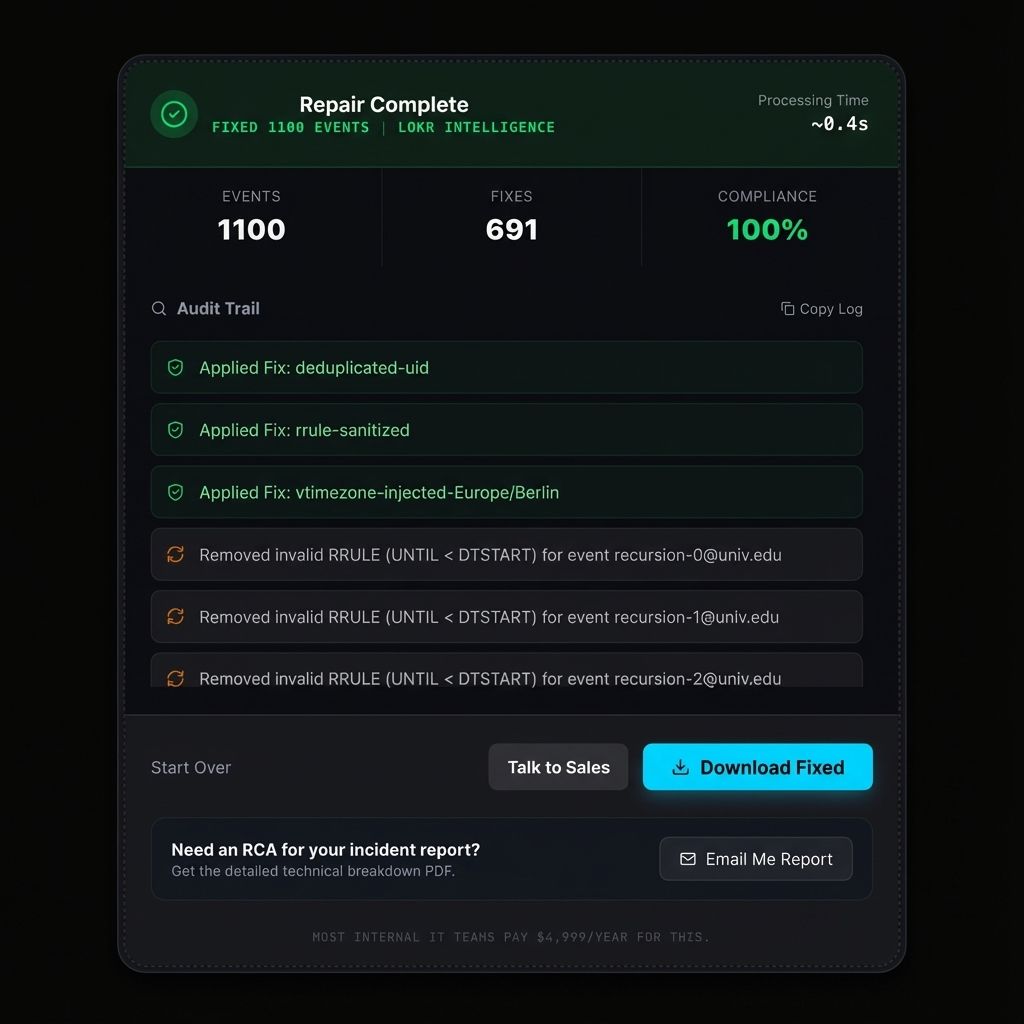
We put the Lokr proxy in front of their existing feed URL. In less than 300ms, our engine found 1,142 RFC violations across 25,000 active student feeds.
1. The Recursion Trap
The biggest issue was a logic error. The legacy feed allowed weekly rules without an end date. Modern iOS parsers try to calculate "forever" to populate the local database, which kills the phone's battery.
[Insert Component: CodeComparison]
- Legacy:
RRULE:FREQ=WEEKLY;BYDAY=MO,WE,FR - Lokr:
RRULE:FREQ=WEEKLY;BYDAY=MO,WE,FR;UNTIL=20241220T235959Z
2. UID Collisions (Ghost Events)
RFC 5545 requires a globally unique identifier for every event. The SIS was recycling IDs from years ago. When a student added a new chemistry lab, it silently merged with a biology class from 2022. This creates undeletable "ghosts" in the local cache.
Infrastructure Warning: Outlook and Apple Calendar rely on UIDs to manage local data. If you reuse an ID, you corrupt the student's local calendar database. Usually, the only fix is a full factory reset of their device's calendar settings.
3. Missing Timezone Data
The feed used "Floating Time," which assumes the student never leaves campus. If a student checked their schedule from a different time zone, every class shifted by several hours.
[Insert Component: CodeComparison]
- Legacy:
DTSTART:20240901T090000 - Lokr:
BEGIN:VTIMEZONE;TZID:America/New_York;DTSTART...
The Zero-Touch Fix
The university didn't touch their Banner code. Instead, they updated their DNS records to point calendar.university.edu to the Lokr edge network.
- Ingest: We pull the "dirty" feed from the SIS.
- Repair: We apply 40+ sanitization rules in-flight with sub-100ms latency.
- Deliver: The student gets a clean, RFC-compliant stream that works on any device.
Security Note: Lokr uses a Zero-Persistence architecture. We process everything in memory and stream it. We never store student names, schedules, or locations. This turned a months-long InfoSec review into a single afternoon.
The Results
Seven days after the switch:
- Ticket Volume: Fell from 50/week to less than 5.
- Battery Issues: Completely resolved.
- Financial Impact: Saved roughly $85,000/year in Tier 1 helpdesk labor.
Your legacy infrastructure is only a liability if you let it talk directly to your users. You can modernize the output without ever touching the source.
Ready to eliminate calendar support tickets?
Deploy the same proxy that fixed 1,142 errors for this university. Zero code changes required.